Ted Bundy: not a genius
Pop culture sells him as the charming, brilliant killer who outwitted everyone. The record shows two traffic stops, two lax jails, a survivor who testified, and three trials he lost. Follow the string from Washington in 1974 to Florida in 1989, and see a man stopped by ordinary police work and outlasted by the courts.
Ted Bundy: The Myth, the Escapes, and the Courtroom That Finally Held Him
True Crime Files, No. 2 — by The Law Girl
Pop culture loves a monster in a suit. Nearly fifty years later, Ted Bundy is still sold as the “charming,” “brilliant” killer who outwitted everyone. Movies cast heartthrobs to play him.
I’m The Law Girl, and I won’t add to that. The record shows a man stopped by ordinary police work, convicted on survivor and eyewitness testimony, and outlasted by a legal system he tried and failed to manipulate. His case also raised questions lawyers still argue about: the right to defend yourself, cameras in the courtroom, and forensic “science” that turned out to be much less than it claimed. Part of this story happened right here in Colorado.
My usual promise applies. This is about the case and the law, not the violence. The women and girls he killed are named with respect, as they appear in the public record.
The Case File
| Defendant | Theodore Robert Bundy, born Theodore Robert Cowell on Nov. 24, 1946, in Burlington, Vermont |
|---|---|
| Known crimes | Abductions and murders of young women and girls, 1974–1978, in Washington, Oregon, Utah, Colorado, Idaho, and Florida |
| Convicted of | Utah, 1976: aggravated kidnapping of Carol DaRonch. Florida, 1979: two counts of first-degree murder, three counts of attempted first-degree murder, and two counts of burglary (the Chi Omega case). Florida, 1980: kidnapping and first-degree murder of Kimberly Leach |
| Charged, never tried | Colorado: the 1975 murder of Caryn Campbell |
| Escapes | Pitkin County Courthouse, Aspen (June 7, 1977); Garfield County Jail, Glenwood Springs (Dec. 30, 1977) |
| FBI Ten Most Wanted | Added Feb. 10, 1978 (fugitive No. 360) |
| Final arrest | Feb. 15, 1978, Pensacola, Florida, in a stolen car |
| Sentences | Three death sentences (two for Chi Omega, one for Leach) |
| Executed | Jan. 24, 1989, Florida State Prison, near Starke, age 42 |
| Admitted | About 30 murders in seven states, confessed in his final days. The true total is unknown |
Timeline
- 1974: Young women begin disappearing in Washington and Oregon. That fall, Bundy moves to Salt Lake City for law school, and disappearances begin in Utah.
- Nov. 8, 1974: Posing as a police officer, Bundy lures 18-year-old Carol DaRonch from a mall in Murray, Utah. She fights him off and escapes.
- January 1975: Caryn Campbell, a 23-year-old nurse, disappears from the Wildwood Inn in Snowmass Village, Colorado.
- Aug. 16, 1975: A Utah trooper stops Bundy’s Volkswagen near Salt Lake City and finds handcuffs, a ski mask, and a crowbar.
- March 1, 1976: A Utah judge convicts Bundy of aggravated kidnapping after a bench trial.
- June 7, 1977: First escape, from the Pitkin County Courthouse. He is recaptured within a week.
- Dec. 30, 1977: Second escape, from the Garfield County Jail in Glenwood Springs. He makes his way to Tallahassee.
- Jan. 15, 1978: The Chi Omega attack at Florida State University. Margaret Bowman and Lisa Levy are killed.
- Feb. 9, 1978: Kimberly Leach, 12, is abducted from her school in Lake City, Florida.
- Feb. 15, 1978: A Pensacola officer arrests Bundy in a stolen car.
- July 24, 1979: A Miami jury convicts him in the Chi Omega case. He is sentenced to death a week later.
- Feb. 7, 1980: An Orlando jury convicts him of Kimberly Leach’s kidnapping and murder.
- Jan. 24, 1989: Bundy is executed in Florida’s electric chair.
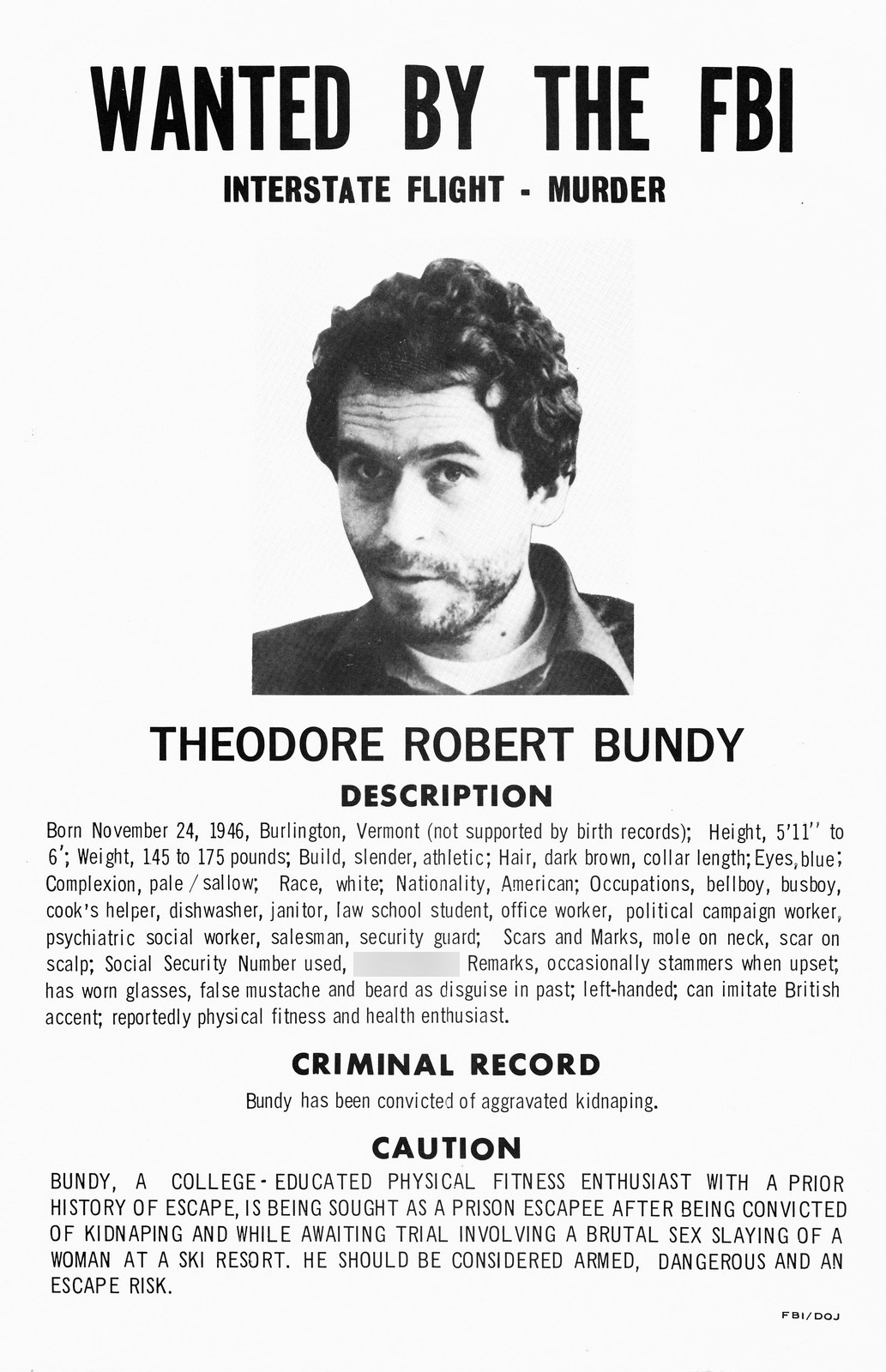
Image: Federal Bureau of Investigation (1978). Public domain (U.S. government work).
Caught by the Basics
The Bundy myth says he was too smart to catch. The record says otherwise.
In August 1975, Utah Highway Patrol Sgt. Bob Hayward pulled over a Volkswagen in a Salt Lake City suburb in the middle of the night. Inside were handcuffs, a ski mask, a crowbar, and other tools. Detectives connected Bundy to the DaRonch kidnapping, and Carol DaRonch identified him in a lineup. He was convicted and sentenced to 1 to 15 years in the Utah State Prison.
A traffic stop, and a survivor who fought back and then testified. Remember that pattern. It repeats.
The Colorado Chapter: Two Escapes
In January 1977, Bundy was transferred to Aspen to stand trial for Caryn Campbell’s murder. Acting as his own attorney, he got access to the Pitkin County Courthouse law library and appeared in court without leg restraints.
Escape one: Aspen, June 7, 1977. During a recess at a pretrial hearing, Bundy went to the second-floor law library and jumped from a window. He fled into the mountains. Within a week, officers caught him driving a stolen car back in Aspen. He hadn’t gotten far.
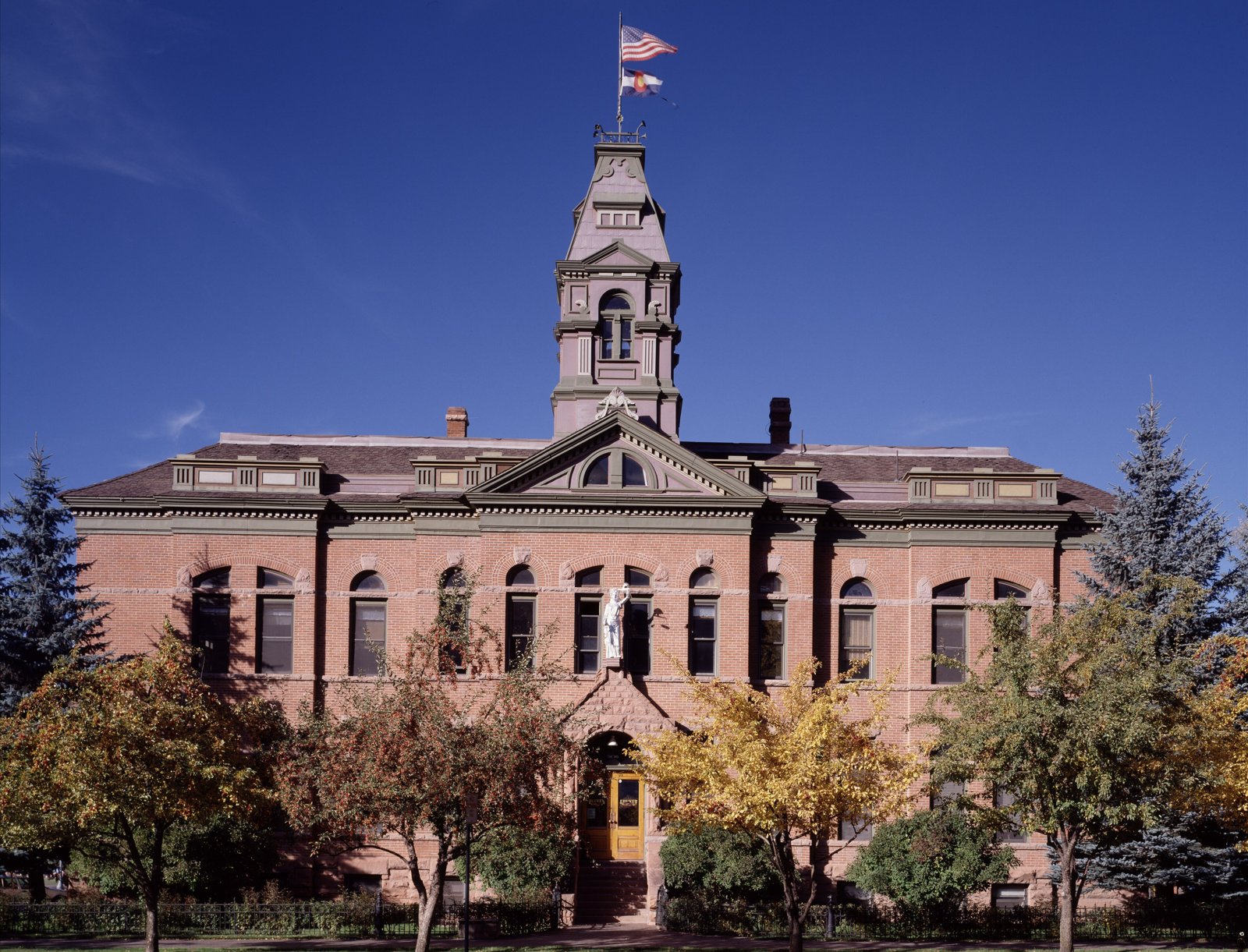
Image: Carol M. Highsmith, Carol M. Highsmith Archive, Library of Congress, Prints and Photographs Division. Public domain.
Escape two: Glenwood Springs, Dec. 30, 1977. After the first escape, Bundy was held at the old Garfield County Jail in Glenwood Springs. That building is long gone. He squeezed through a small hole in his cell ceiling at a light fixture, crawled through the space above the cells, and came out through the jailer’s apartment. He had left books under his blanket to look like a sleeping body, and staff didn’t notice he was gone until about noon the next day. He made his way to Denver and flew to Chicago. About a week later he was renting a room near the Florida State campus in Tallahassee.
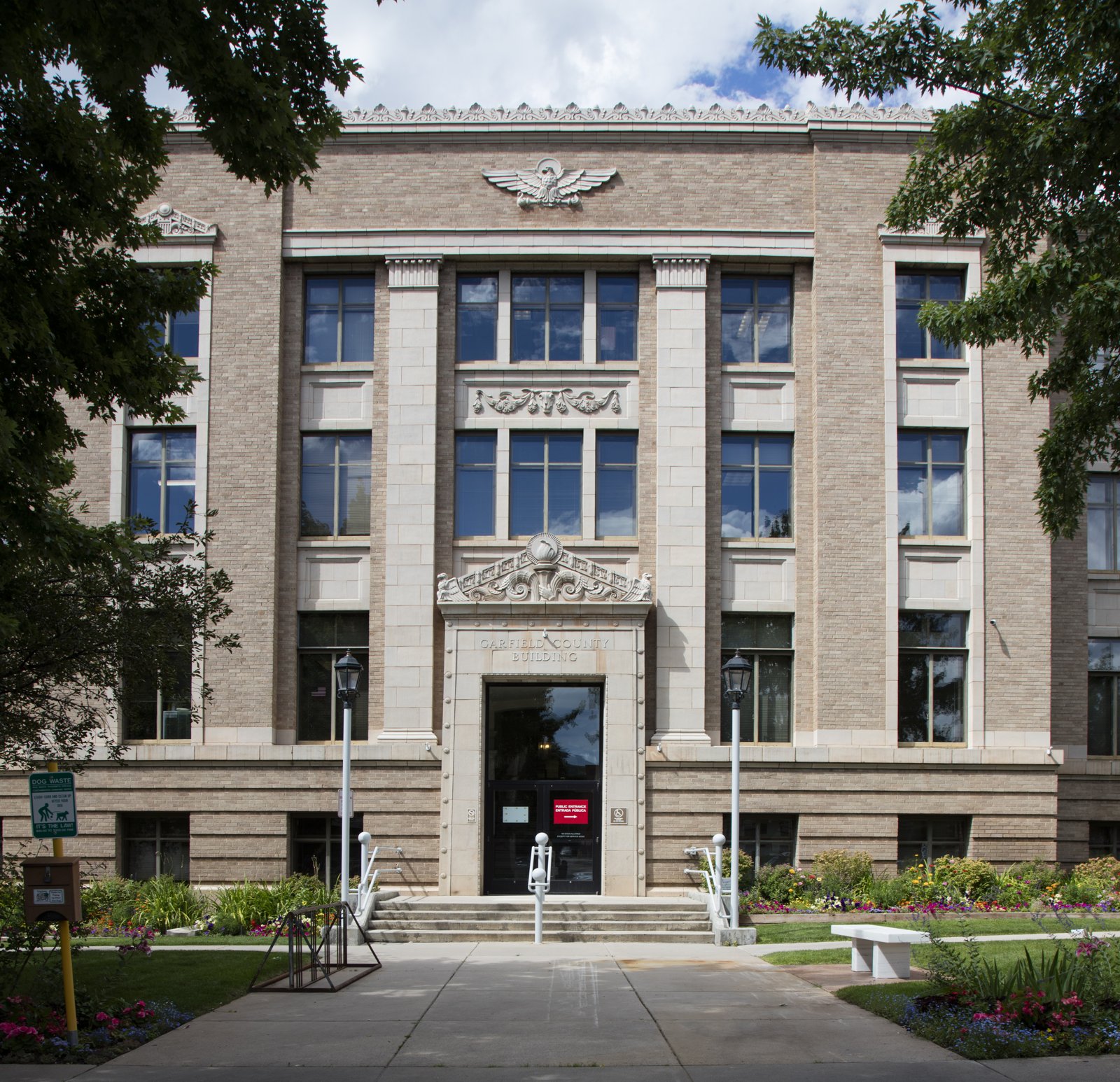
Image: Carol M. Highsmith, Gates Frontiers Fund Colorado Collection, Carol M. Highsmith Archive, Library of Congress, Prints and Photographs Division. Public domain.
The Campbell charge never went to trial. Bundy later confessed to killing Julie Cunningham in Vail and Denise Oliverson in Grand Junction in 1975. Their remains have never been found.
Florida: The Last Six Weeks
About a week after he arrived, in the early hours of Jan. 15, 1978, Bundy entered the Chi Omega sorority house at FSU. Margaret Bowman and Lisa Levy were killed, and Kathy Kleiner and Karen Chandler were seriously injured. A sorority sister, Nita Neary, saw a man leaving the house around 3 a.m. About an hour later and a few blocks away, FSU student Cheryl Thomas was attacked in her apartment. She survived.
On Feb. 9, 1978, Bundy abducted 12-year-old Kimberly Leach from Lake City Junior High School. Her remains were found that April near Suwannee River State Park.
On Feb. 10, the FBI put him on its Ten Most Wanted list. Five days later, a patrol officer caught him again. Around 1:30 a.m. on Feb. 15, a Pensacola officer ran the plates on a suspicious Volkswagen and found it was stolen. Bundy ran, struggled, and was arrested. At the station he gave a false name.
The Trials
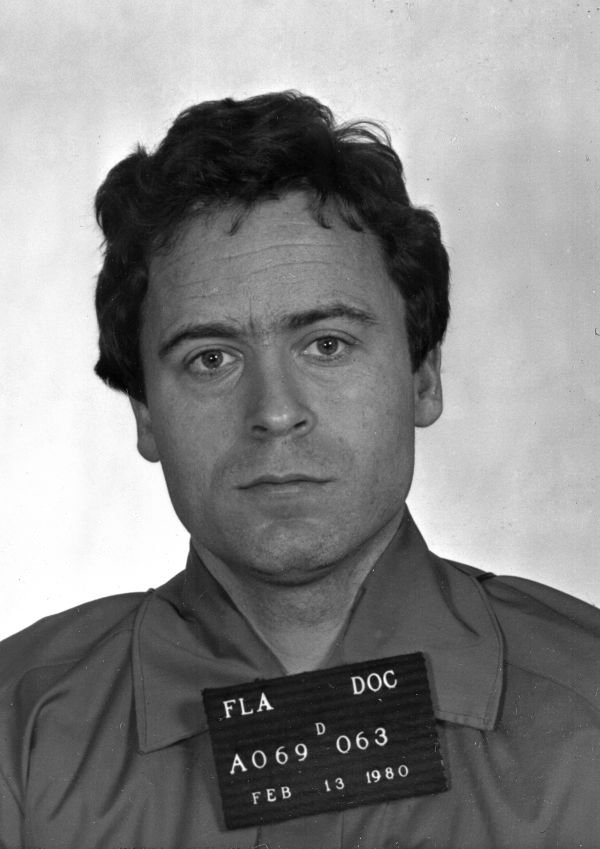
Image: Florida Department of Corrections, State Archives of Florida, Florida Memory. Public domain under Florida law (§ 257.35(6), Fla. Stat.).
Chi Omega (Miami, 1979). With no impartial jury possible in Tallahassee, the trial moved to Miami before Judge Edward D. Cowart. Bundy had court-appointed lawyers, but he insisted on running much of his own defense, including cross-examining witnesses. Television cameras broadcast the trial nationwide.
Nita Neary identified Bundy as the man she saw leaving. Two forensic dentists testified that a bite mark on Lisa Levy matched his teeth. Prosecutors also pointed to his flight and false identities. On July 24, 1979, the jury found him guilty on all counts. Judge Cowart sentenced him to death for both murders.
Kimberly Leach (Orlando, 1980). Judge Wallace Jopling presided. The evidence included fibers and a witness, Clarence Anderson, who said he saw a man resembling Bundy leading a girl to a white van near the school. Anderson’s memory had been “refreshed” under hypnosis, which mattered on appeal. On Feb. 7, 1980, the jury convicted Bundy of kidnapping and first-degree murder, and he was sentenced to death.
Appeals, Warrants, and the End
The Florida Supreme Court upheld the Chi Omega convictions in 1984 and the Leach conviction in 1985. Death warrants signed beginning in 1986 were stayed while federal courts reviewed the cases, including a hearing on whether Bundy had been competent to stand trial. A federal judge found that he was, and in July 1988 the Eleventh Circuit rejected every remaining claim in the Leach case.
In January 1989, after the U.S. Supreme Court declined to intervene, Gov. Bob Martinez signed a final death warrant. Through intermediaries, Bundy offered to discuss unsolved murders in other states if his execution was delayed. Martinez refused: “For him to negotiate for his life over the bodies of his victims is despicable.”
In his final days Bundy confessed to detectives from several states and to an FBI agent. Published counts of his admitted murders run from 28 to about 30. For families, the confessions settled doubts but brought no peace. He was executed on Jan. 24, 1989, for the murder of Kimberly Leach, and pronounced dead at 7:16 a.m.
The Law Girl’s Take
1. Faretta: the right to be your own lawyer, and the cost
In Faretta v. California (1975), the U.S. Supreme Court held that the Sixth Amendment protects a defendant’s right to represent himself. The waiver of counsel must be knowing and intelligent, and the court should warn him about the dangers. But the choice is his.
Bundy leaned on this right in Colorado and Florida. In the Leach case, after the court refused to admit an out-of-state attorney he wanted, he invoked Faretta and represented himself for months before accepting appointed counsel. On appeal he claimed the court hadn’t properly questioned him before letting him waive counsel. The Eleventh Circuit found any error harmless and the claim procedurally defaulted. His own choice became his argument for reversal.
The bigger cost was a plea deal. According to the Eleventh Circuit’s opinion, the state had agreed to life sentences in both Florida cases. At the plea proceeding, Bundy attacked his own lawyers’ effectiveness instead of entering the plea, and the state withdrew the offer. The supposed genius talked himself out of the one deal that would have kept him alive.
2. The Colorado escapes and courtroom security
Being your own lawyer doesn’t give you a right to roam. Under Deck v. Missouri (2005), visible shackles before a jury require a security justification specific to the defendant, and a convicted kidnapper facing a murder charge is exactly that defendant. Aspen gave a high-risk prisoner pro se privileges, no leg restraints, and a second-story window. Glenwood Springs ran a jail where a prisoner could work on a hole in his ceiling and be gone for hours unnoticed. Those failures cost lives in Florida.
3. Cameras in the courtroom
Florida opened its courtrooms to cameras in 1979 (In re Post-Newsweek Stations). The Chi Omega trial that summer is widely described as the first, or one of the first, nationally televised U.S. criminal trials. In Chandler v. Florida (1981), the U.S. Supreme Court held that broadcasting a trial doesn’t by itself violate due process; a defendant must show actual prejudice. Bundy moved to restrict the cameras, then, by one of his public defenders’ account, played to them once they rolled. The broadcast turned a defendant playing lawyer into a celebrity, the part of this legacy I’d undo.
4. Bite marks: the evidence that aged badly
The Chi Omega trial was a showcase for forensic odontology, and the Florida Supreme Court upheld the bite-mark testimony. Since then, the science has come apart:
- 2009: A National Academy of Sciences report found no scientific studies supporting the claim that a bite mark can be matched to one person.
- 2016: The President’s Council of Advisors on Science and Technology (PCAST) found bite-mark analysis “far from meeting” scientific standards for validity. That same year, the Texas Forensic Science Commission recommended that courts stop admitting it until it was validated.
- 2023: A NIST review concluded the field’s core premises (unique dentition, accurate transfer to skin, reliable examiner matching) aren’t supported by data.
Bundy’s guilt doesn’t depend on that testimony. Neary’s identification, his flight, the Leach evidence, and his confessions settle it. That’s the danger: a famous guilty verdict lent credibility to a technique since tied to wrongful convictions of other people. A right result doesn’t prove the method was sound.
5. Hypnosis on the witness stand
In the Leach appeal, Bundy v. State (1985), the Florida Supreme Court held that hypnotically refreshed testimony is per se inadmissible in Florida. It still affirmed, finding the error harmless given Anderson’s pre-hypnosis statements and the other evidence. Florida’s per se rule came out of a Bundy appeal.
6. Was justice too slow?
Nine years passed between the Leach verdict and the execution. That wasn’t a loophole; it was the system checking its work in a death case. Every claim was heard, and every one failed.
Retiring the Myth
“For him to negotiate for his life over the bodies of his victims is despicable.”
Florida Gov. Bob Martinez, Jan. 18, 1989 (UPI)
The real Ted Bundy drifted through low-wage jobs, never finished law school, got caught at two traffic stops, and lost three trials. A survivor picked him out of a lineup, and a witness saw him at 3 a.m. His escapes worked because jails were lax, not because he was a genius. His crimes required no brilliance, only a willingness to exploit kindness, like wearing an arm sling or posing as a police officer.
Martinez said it plainly in 1989: “He has basically lied through the entire process.” The charming-genius story is one more of his lies. Stop repeating it.
Remembering the Victims
The names below appear in court records, his confessions, and investigative reporting. Some victims may never be identified. Each was a whole person with a family that waited years for answers.
- Washington and Oregon, 1974: Lynda Ann Healy, Donna Gail Manson, Susan Elaine Rancourt, Roberta Kathleen Parks, Brenda Carol Ball, Georgann Hawkins, Janice Ott, Denise Marie Naslund
- Utah, 1974–1975: Melissa Anne Smith, Laura Ann Aime, Debra Jean Kent, Susan Curtis
- Colorado, 1975: Caryn Eileen Campbell, Julie Cunningham, Denise Lynn Oliverson
- Idaho, 1975: Lynette Dawn Culver
- Florida, 1978: Margaret Bowman, Lisa Levy, Kimberly Dianne Leach
The survivors include Carol DaRonch, Kathy Kleiner, Karen Chandler, and Cheryl Thomas. Several testified against him.
In January 1989, Denise Naslund’s mother, Eleanore Rose, told UPI she hoped Bundy would talk “to put our minds at ease.” The people who matter in this story are the ones he hurt.
— The Law Girl
Sources
- FBI, “Serial Killers, Part 3: Ted Bundy’s Campaign of Terror.” https://www.fbi.gov/news/stories/serial-killers-part-3-ted-bundys-campaign-of-terror1
- FBI, Ten Most Wanted Fugitives FAQ, fugitives 301–400 (Bundy, No. 360, added Feb. 10, 1978). https://www.fbi.gov/wanted/topten/ten-most-wanted-fugitives-faq/ten-most-wanted-301-400
- FBI Image Repository, “Bundy Wanted Poster.” https://www.fbi.gov/image-repository/history/bundy-wanted-poster.jpeg/view
- Bundy v. State, 455 So. 2d 330 (Fla. 1984) (Chi Omega appeal). https://law.justia.com/cases/florida/supreme-court/1984/57772-0.html
- Bundy v. State, 471 So. 2d 9 (Fla. 1985) (Leach appeal; hypnotically refreshed testimony). https://law.justia.com/cases/florida/supreme-court/1985/59128-0.html
- Bundy v. Florida, 479 U.S. 894 (1986) (cert. denied). https://supreme.justia.com/cases/federal/us/479/894/
- Bundy v. Dugger, 850 F.2d 1402 (11th Cir. 1988) (Faretta, counsel, competency, the withdrawn plea offer). https://law.resource.org/pub/us/case/reporter/F2/850/850.F2d.1402.86-3773.html
- Faretta v. California, 422 U.S. 806 (1975). https://supreme.justia.com/cases/federal/us/422/806/
- Chandler v. Florida, 449 U.S. 560 (1981). https://supreme.justia.com/cases/federal/us/449/560/
- Deck v. Missouri, 544 U.S. 622 (2005). https://supreme.justia.com/cases/federal/us/544/622/
- In re Post-Newsweek Stations, Florida, Inc., 370 So. 2d 764 (Fla. 1979).
- Denver Public Library, Western History, “‘The Very Definition of Heartless Evil’: Ted Bundy in Colorado.” https://history.denverlibrary.org/news/%E2%80%9C-very-definition-heartless-evil%E2%80%9D-ted-bundy-colorado
- Glenwood Springs Post Independent / Aspen Times, “Bundy’s escape forever a part of Garfield County history.” https://www.aspentimes.com/news/bundys-escape-forever-a-part-of-garfield-county-history/
- Sopris Sun, “Pages of the Past.” https://soprissun.com/pages-of-the-past-a-manhunt-teen-gangs-and-plenty-of-hot-air/
- ABC News, “Notorious serial killer Ted Bundy’s escapes from custody,” 2019. https://abcnews.com/US/notorious-serial-killer-ted-bundy-escape-custody/story?id=61032623
- ABC News, “Timeline of many of Ted Bundy’s brutal crimes,” Feb. 15, 2019. https://abcnews.com/US/timeline-ted-bundys-brutal-crimes/story?id=61077236
- Miami New Times, “Ted Bundy’s Murder Trial in Miami Foreshadowed True Crime Fandom.” https://www.miaminewtimes.com/arts-culture/ted-bundy-murder-trial-in-miami-foreshadowed-true-crime-fandom-11070191/
- The New York Times, “Bundy Guilty of Murders of Two Florida Women,” July 25, 1979. https://www.nytimes.com/1979/07/25/archives/bundy-guilty-of-murders-of-two-florida-women-penalty-deliberations.html
- The Washington Post, “Slayer Bundy Sentenced to Electric Chair in Fla.,” Aug. 1, 1979. https://www.washingtonpost.com/archive/politics/1979/08/01/slayer-bundy-sentenced-to-electric-chair-in-fla/e60eb6a7-40f0-4a34-8104-9f82c3b119cc/
- Deseret News, “The Trials of Ted Bundy,” Jan. 24, 1989. https://www.deseret.com/1989/1/24/18792831/the-trials-of-ted-bundy/
- UPI, “Gov. Bob Martinez said Wednesday he rejected a ‘despicable’…,” Jan. 18, 1989. https://www.upi.com/Archives/1989/01/18/Gov-Bob-Martinez-said-Wednesday-he-rejected-a-despicable/1114601102800/
- UPI, “A chronology of events leading to Ted Bundy’s execution,” Jan. 24, 1989. https://www.upi.com/Archives/1989/01/24/A-chronology-of-events-leading-to-Ted-Bundys-execution/4811601621200/
- UPI, “Serial sex killer Theodore Bundy, who confessed to murdering…,” Jan. 24, 1989. https://www.upi.com/Archives/1989/01/24/Serial-sex-killer-Theodore-Bundy-who-confessed-to-murdering/8173601621200/
- Los Angeles Times, Jan. 24, 1989. https://www.latimes.com/archives/la-xpm-1989-01-24-mn-1075-story.html
- The New York Times, “Bundy Is Put to Death in Florida After Admitting Trail of Killings,” Jan. 25, 1989. https://www.nytimes.com/1989/01/25/us/bundy-is-put-to-death-in-florida-after-admitting-trail-of-killings.html
- The New York Times, “For Families, Killer’s Death Eases Doubts but Not Pain,” Feb. 13, 1989. https://www.nytimes.com/1989/02/13/us/for-families-killer-s-death-eases-doubts-but-not-pain.html
- National Research Council, Strengthening Forensic Science in the United States: A Path Forward (2009). https://www.ojp.gov/pdffiles1/nij/grants/228091.pdf
- PCAST, Forensic Science in Criminal Courts: Ensuring Scientific Validity of Feature-Comparison Methods (2016). https://obamawhitehouse.archives.gov/sites/default/files/microsites/ostp/PCAST/pcast_forensic_science_report_final.pdf
- Texas Forensic Science Commission, FY2016 Annual Report (bitemark recommendation). https://txcourts.gov/media/1462103/fsc-annual-report-fy2016.pdf
- NIST, Bitemark Analysis: A NIST Scientific Foundation Review, NISTIR 8352 (2023). https://nvlpubs.nist.gov/nistpubs/ir/2023/NIST.IR.8352.pdf
- Wikipedia, “Ted Bundy” (used only as a pointer to primary sources). https://en.wikipedia.org/wiki/Ted_Bundy
Image credits: FBI wanted poster (1978), public domain as a U.S. federal work. Two Carol M. Highsmith photographs from the Library of Congress, dedicated to the public domain. Florida Department of Corrections photograph via the State Archives of Florida, public domain under § 257.35(6), Fla. Stat. See image-credits.md for details.
Content is for general informational purposes only and is not legal advice. No attorney-client relationship is created.