The Golden State Killer: follow the string
You’ve just been handed the file. Thirteen murders. 87 victims at 53 crime scenes. Eleven California counties. A case that stayed cold for more than forty years. Open any pin, or follow the timeline from the first Visalia burglaries to the 2020 sentencing and see how preserved evidence and a family tree finally put a name to the DNA.
The Golden State Killer: How a Cold Case Met Its Match in a Family Tree
True Crime Files, No. 1 — by The Law Girl
Some cases go cold. This one froze solid. For more than forty years, the man who terrorized California neighborhoods and killed thirteen people lived a quiet suburban life. He fixed trucks. He raised a family. When he was finally caught in April 2018, it wasn’t because of a confession, a tip, or a lucky traffic stop. It was a family tree full of distant cousins.
I’m The Law Girl, and this is the first of my True Crime Files. We start with the case that changed how American police hunt for strangers. I’ll cover what happened and how it was solved. Then I’ll get to the part I care about most: what the law did with this case, and what it still hasn’t figured out.
A promise before we start. This file is about the case and the legal system, not the violence. The people he hurt aren’t plot points. They’re named here only as they appear in the public record, and with respect.
The Case File
| Defendant | Joseph James DeAngelo Jr. (born 1945) |
|---|---|
| Also known as | Visalia Ransacker; East Area Rapist; Original Night Stalker; “EARONS”; Golden State Killer |
| Former career | Police officer in Exeter (1973–76) and Auburn (1976–79), California |
| Active | Mid-1970s to 1986. The earliest charged crime was in 1975 and the last in 1986 |
| Region | 11 California counties, from Tulare and Sacramento to the Bay Area, Santa Barbara, Ventura, and Orange |
| Convicted of | 13 counts of first-degree murder with special circumstances; 13 counts of kidnapping to commit robbery |
| Admitted, uncharged | More than 161 crimes against 61 more victims, including rape |
| Total victims (per prosecutors) | 87 victims at 53 crime scenes |
| Arrested | April 24, 2018, Citrus Heights (Sacramento County), age 72 |
| Plea | June 29, 2020 |
| Sentence | August 21, 2020: 11 consecutive terms of life without parole, plus a consecutive life term and 8 years. He waived all appeals |
Timeline
- 1974–75: A string of burglaries hits Visalia. Police call the burglar the “Visalia Ransacker.” At the time, DeAngelo is a police officer in nearby Exeter.
- September 11, 1975: Professor Claude Snelling is shot and killed in Visalia while protecting his teenage daughter. It is the earliest of the 13 murders DeAngelo later admitted.
- June 18, 1976: The first “East Area Rapist” attack happens in suburban Sacramento, according to the FBI. Dozens more follow through 1979 in Sacramento, Stockton, Modesto, Davis, and the East Bay.
- February 2, 1978: Brian and Katie Maggiore are killed while walking their dog in Rancho Cordova.
- 1979: DeAngelo is arrested for shoplifting a hammer and dog repellent. Auburn police later fire him.
- 1979–1981: In Southern California, the “Original Night Stalker” kills ten people. The victims are Robert Offerman and Debra Alexandria Manning in Goleta, Lyman and Charlene Smith in Ventura, Keith and Patrice Harrington in Dana Point, Manuela Witthuhn in Irvine, and Cheri Domingo and Gregory Sanchez in Goleta.
- May 1986: Janelle Cruz, 18, is killed in Irvine. She is the last known victim.
- 2001: DNA links the northern and southern crime series to one man.
- June 15, 2016: The FBI and local partners announce a $50,000 reward and a national publicity campaign.
- Early 2018: Investigators use crime-scene DNA and the genealogy site GEDmatch to narrow the search to DeAngelo.
- April 18–23, 2018: Investigators collect DNA from his car door handle and a discarded tissue. Both match.
- April 24, 2018: DeAngelo is arrested.
- June 29, 2020: He pleads guilty.
- August 17–21, 2020: Victims and families give impact statements. On August 21 he is sentenced to life without parole.
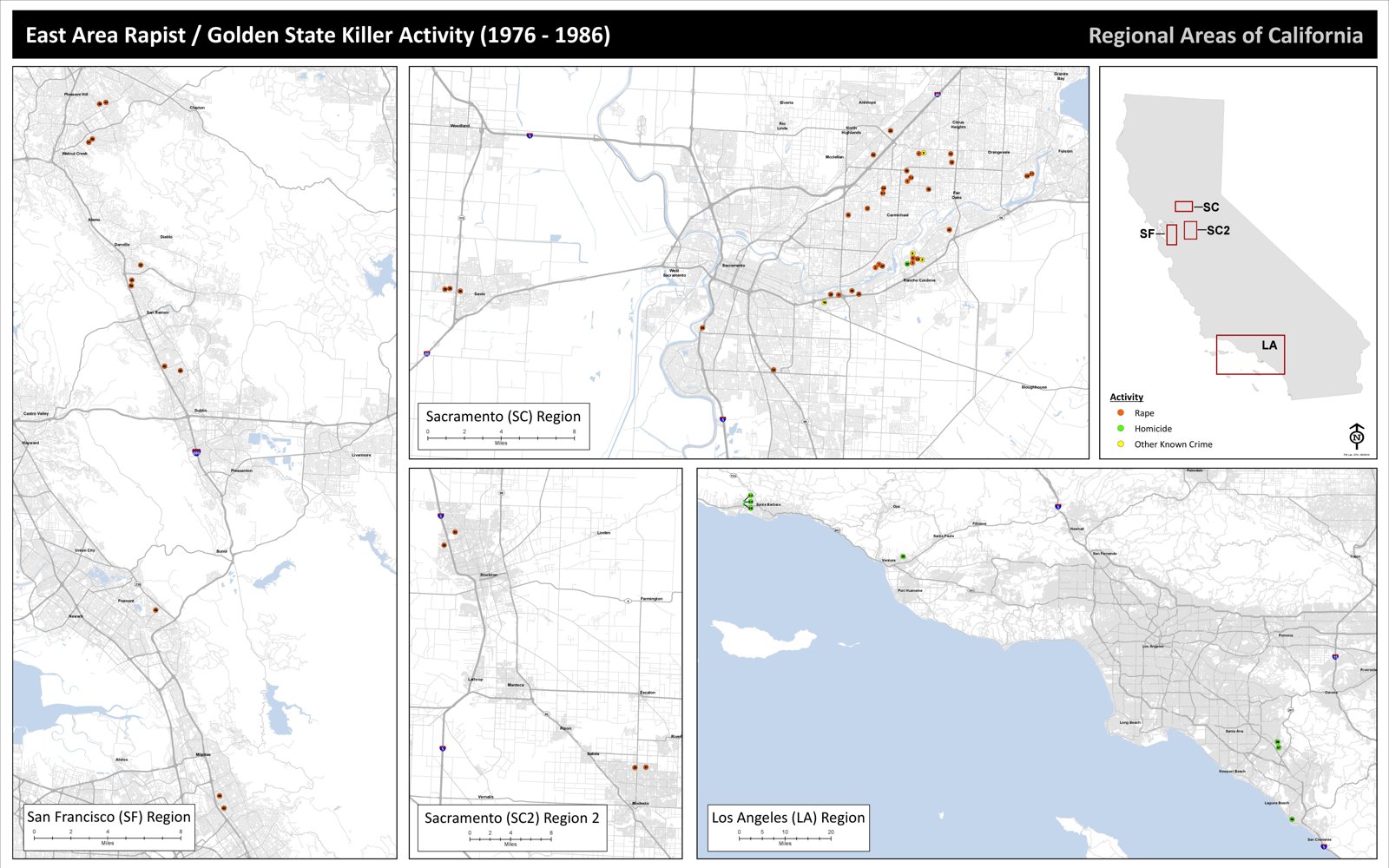
Image: Federal Bureau of Investigation (2016). Public domain (U.S. government work), via Wikimedia Commons.
How the Case Went Cold
This case didn’t stay open because nobody tried. Generations of detectives worked it. Four things worked against them.
He kept moving, and the agencies didn’t connect the cases. The crimes crossed eleven counties and dozens of jurisdictions. In the north he was a rapist, and in the south he was a killer. Departments used different labs and methods, and DNA didn’t link the two series until 2001.
The science wasn’t there yet. Investigators in the 1970s preserved biological evidence before DNA profiling existed. When DNA arrived, it could link crime scenes to each other. It could only name a suspect if his profile was already in a criminal database, and DeAngelo’s wasn’t. In the FBI’s 2016 video on the case, an investigator put it this way: “We have identified the DNA for East Area Rapist. We just don’t have a face or name for that DNA.”
He stopped. There were no known attacks after 1986, which meant no new evidence and no new witnesses.
He hid in plain sight. He was a fired cop who became a family man, and he spent decades as a mechanic at a grocery distribution center.

Image: Federal Bureau of Investigation (2016). Public domain (U.S. government work), via Wikimedia Commons.
The Breakthrough: A Family Tree, Not a Fingerprint
At the time, GEDmatch was a free site run by genealogy hobbyists. Users uploaded raw data from consumer DNA tests to find relatives. According to the New York Times, a Contra Costa County DA investigator named Paul Holes worked with an FBI lawyer to upload a genetic profile built from crime-scene DNA, using a pseudonym. Later-unsealed warrants show the sample came from the 1980 Ventura murders of Lyman and Charlene Smith.
The site didn’t return the killer. It returned distant relatives who shared ancestors with him generations back. From there, investigators and genealogist Barbara Rae-Venter built family trees forward from those ancestors. They ruled people out by age, sex, and geography until they reached a man in Citrus Heights.
Next they needed a direct sample. According to warrant records reported by the Associated Press and the Los Angeles Times, investigators swabbed DeAngelo’s car door handle in a store parking lot on April 18, 2018. Days later they took a tissue from his curbside trash, which gave them the confirmation they needed. Ventura County District Attorney Greg Totten later said it was the first time genetic genealogy had been used to solve a rape or murder. Investigators across the country have since used the technique, now called investigative genetic genealogy (IGG), to identify suspects in other cold cases.
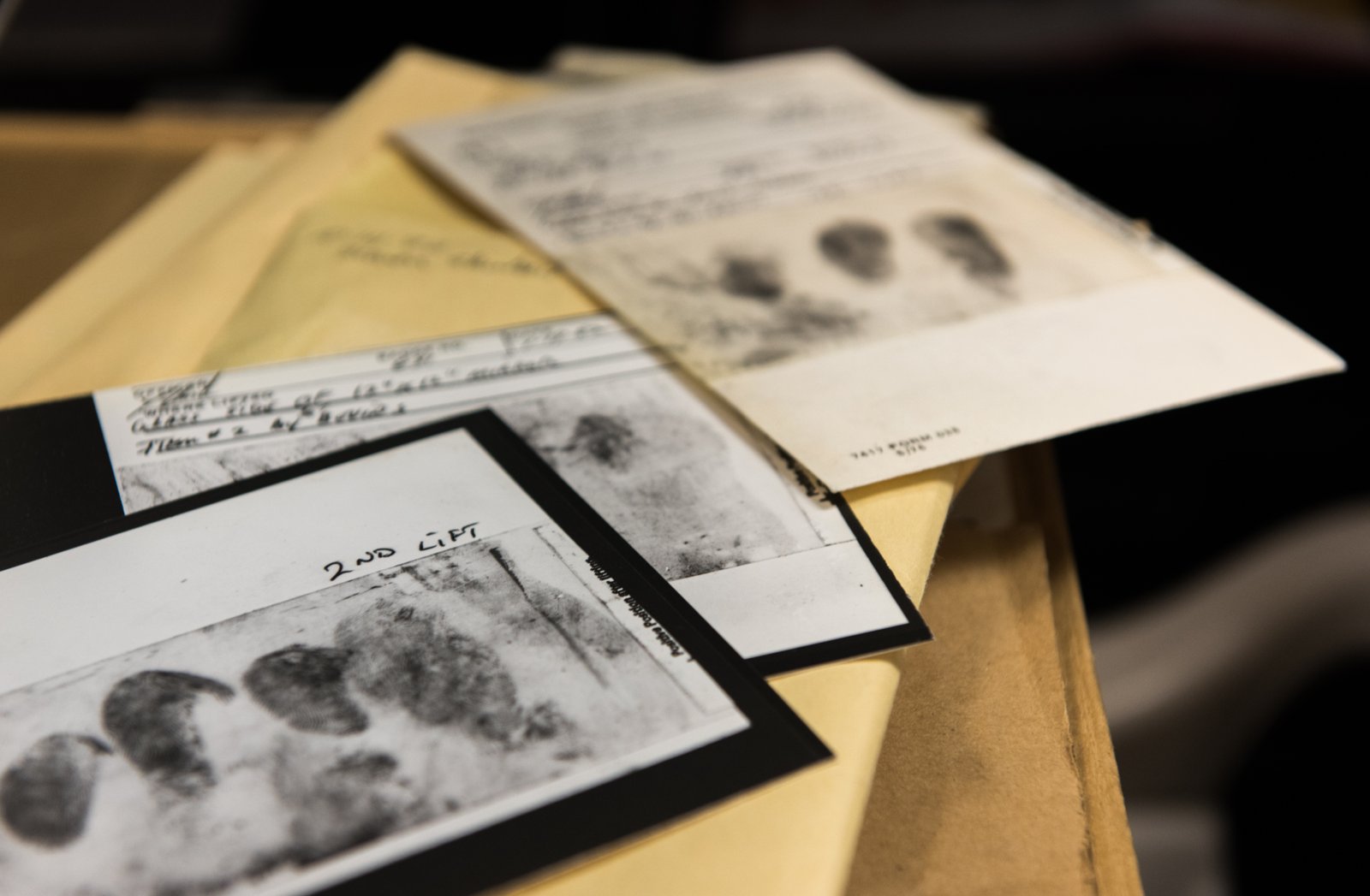
Image: Federal Bureau of Investigation (2016). Public domain (U.S. government work), via Wikimedia Commons.
The privacy problem
None of the relatives whose DNA led to DeAngelo were suspected of anything. They uploaded their data to learn about their ancestry, and police used it to find a relative.
The rules have tightened since then. In May 2019, GEDmatch made law-enforcement matching opt-in for every user. The U.S. Department of Justice issued an interim policy, effective November 1, 2019, that generally limits federal use of the technique to violent crimes like homicide and sexual assault. Under that policy, standard DNA database searches have to come first. Maryland passed a 2021 law requiring a judge’s approval before investigators can run a genealogy search.
Arrest, Plea, and Why There Was No Trial
DeAngelo was first charged with eight murders. Santa Barbara and Tulare counties added more counts, and in August 2018 the cases were consolidated in Sacramento under a joint prosecution by six district attorneys. In April 2019 those prosecutors announced they would seek the death penalty.
So why was there no trial? There were three reasons.
- Time. According to the joint DA release, the case involved more than 1.3 million pages of discovery and could have taken as long as 10 years to prosecute. Victims and witnesses had aged, and some key witnesses had died.
- The death penalty was mostly symbolic. In March 2019, Governor Gavin Newsom’s Executive Order N-09-19 put a moratorium on executions in California. Prosecutors could still seek a death sentence, but carrying one out was a different matter.
- The rapes were time-barred. I explain why in my analysis below.
In March 2020, DeAngelo’s lawyers said he would plead guilty if the death penalty was taken off the table. On June 29, 2020, he pleaded guilty to all 13 murders and 13 kidnapping counts. He also admitted more than 161 uncharged crimes. Prosecutors said they made the decision in consultation with victims and their families. The hearing was held in a ballroom at Sacramento State University so people could keep their distance during the pandemic.
Sentencing: “A Day of Reckoning”
“Victims, families and entire communities have waited decades for this day – a day of reckoning.”
Sacramento County District Attorney Anne Marie Schubert, Aug. 21, 2020
For four days in August 2020, survivors and families spoke to the court and to DeAngelo directly. On August 21, Judge Michael Bowman sentenced him to 11 consecutive terms of life without the possibility of parole for the 13 murders, plus a consecutive life term for the kidnappings and eight years for weapon enhancements. According to the BBC, the judge called it the “absolute maximum” the law allowed. Sacramento County District Attorney Anne Marie Schubert called it “a day of reckoning.”
DeAngelo spoke briefly: “I’ve listened to all your statements, each one of them, and I’m truly sorry to everyone I’ve hurt.” You can decide for yourself what that was worth.
The Law Girl’s Take
1. Why murder could be charged after 40 years and rape couldn’t
Under California Penal Code § 799, there’s no statute of limitations for murder or for any crime punishable by death or life in prison. Rape was different. The limitations periods for the 1970s attacks had run out decades before 2018. In 2016, SB 813 eliminated the statute of limitations for rape and certain other sex crimes, but only for offenses committed on or after January 1, 2017, or older cases whose clock hadn’t already run out. It couldn’t revive dead cases, and no law can. In Stogner v. California (2003), the U.S. Supreme Court held that reviving a time-barred prosecution violates the Ex Post Facto Clause.
Prosecutors worked around that. Kidnapping to commit robbery (Penal Code § 209(b)) carries a possible life sentence, so it falls under § 799’s no-limit rule. Those counts let the state charge crimes against surviving victims. The plea also required DeAngelo to admit the uncharged rapes on the record. Survivors whose cases had expired heard him admit what he did, and they were allowed to speak at sentencing.
2. Plea bargaining: a compromise, not a loss
Some people see a plea deal in a death-penalty case as a win for the defendant. I see a trade that served the victims. The state gave up a death sentence that the moratorium made unlikely to be carried out. In exchange it got guilty pleas to every charged murder, admissions to scores of uncharged crimes, life without parole, and a waiver of all appeals. A death verdict would have meant decades of appeals, with survivors pulled back into court again and again. The plea ended the case for good.
3. Genetic genealogy and the Fourth Amendment
Because DeAngelo pleaded guilty and waived his appeals, no court ever ruled on whether the investigation was constitutional. Here’s how the arguments line up.
- The trash and the door handle. In California v. Greenwood (1988), the Supreme Court held that people have no reasonable expectation of privacy in trash left at the curb. A swab from a car door in a public lot is a similar kind of abandoned evidence. Under current law, those confirmation samples are on fairly solid ground.
- The database search. This is the harder question. Under the third-party doctrine (United States v. Miller, 1976; Smith v. Maryland, 1979), you generally lose Fourth Amendment protection in information you voluntarily share with others. But Carpenter v. United States (2018) refused to stretch that doctrine to cover detailed cell-phone location records. Genetic data may be even more revealing, and it exposes relatives who never agreed to share anything.
- Policy is ahead of the courts. For now, the limits on genealogy searches come from company terms (GEDmatch’s opt-in), agency policy (the DOJ), and state law (Maryland). Those are useful guardrails, but they aren’t constitutional rulings, and they vary from place to place.
My view: this case is about as strong as a case for investigative genetic genealogy gets. It involved a serial murderer, decades of conventional leads that went nowhere, and a direct DNA match before the arrest. The danger is that strong facts make it easy to approve a tool, and then the tool gets used in weaker cases. If you’ve uploaded your DNA to a genealogy site, check your settings.
Remembering the Victims
On sentencing day, Orange County District Attorney Todd Spitzer noted that the newlywed Harringtons “never made it to their first wedding anniversary.” Tulare County District Attorney Tim Ward said Claude Snelling “died a true hero.” Each name below was a person with a family and a future.
The 13 people DeAngelo admitted killing, as named in the prosecutors’ joint release:
- Claude Snelling — Visalia, 1975
- Brian Maggiore and Katie Maggiore — Rancho Cordova, 1978
- Robert Offerman and Debra Alexandria Manning — Goleta, 1979
- Lyman Smith and Charlene Smith — Ventura, 1980
- Keith Harrington and Patrice Harrington — Dana Point, 1980
- Manuela Witthuhn — Irvine, 1981
- Cheri Domingo and Gregory Sanchez — Goleta, 1981
- Janelle Cruz — Irvine, 1986
Prosecutors counted 87 victims in all, and many survivors lived with the fear for decades. Some survivors and families spent years keeping the case alive. Keith Harrington’s brother Bruce was the main sponsor of California’s 2004 Proposition 69, which expanded the state’s DNA database.
The case was cold for more than forty years. It was solved by preserved evidence, new science, and people who refused to give up, and its legal questions still aren’t settled.
— The Law Girl
Sources
- Tulare County District Attorney (joint release of six DAs), “Joseph James DeAngelo Jr. Pleads Guilty to 13 Murders, 13 Kidnappings and Dozens of Additional Uncharged Crimes,” June 29/30, 2020. https://tulareda.org/joseph-james-deangelo-jr-pleads-guilty-to-13-murders-13-kidnappings-and-dozens-of-additional-uncharged-crimes/ (PDF: https://tulareda.org/wp-content/uploads/2020/06/6-29-20-Joseph-DeAngelo-Joint-PR.pdf)
- Tulare County District Attorney (joint release), “Joseph James DeAngelo Jr. Sentenced to 11 Consecutive Life Terms without the Possibility of Parole…,” Aug. 21, 2020. https://tulareda.org/joseph-james-deangelo-jr-sentenced-to-11-consecutive-life-terms-without-the-possibility-of-parole-for-13-murders-and-an-additional-consecutive-life-term-for-13-kidnappings/
- People v. Joseph James DeAngelo — official prosecution press materials (factual basis for each plea). https://www.peopleversusjosephdeangelopressmaterials.com
- FBI Sacramento, “FBI Announces $50,000 Reward and National Campaign to Identify East Area Rapist/Golden State Killer,” June 15, 2016 (updated Apr. 25, 2018). https://www.fbi.gov/contact-us/field-offices/sacramento/news/press-releases/fbi-announces-50-000-reward-and-national-campaign-to-identify-east-area-rapist-golden-state-killer
- FBI, “Help Us Catch the East Area Rapist” (news story), June 15, 2016. https://www.fbi.gov/news/stories/help-us-catch-the-east-area-rapist
- FBI, “Clues Sought in Unsolved East Area Rapist Case” (video and transcript), 2016. https://www.fbi.gov/video-repository/ear_061516_final.mp4/view
- Orange County District Attorney, Felony Complaint, People v. DeAngelo, No. 18HF0599, filed Apr. 25, 2018 (as reproduced online). https://pdfcookie.com/documents/joseph-james-deangelo-complaint-3lkzwmkwnplk
- The New York Times, “To Catch a Killer: A Fake Profile on a DNA Site and a Pristine Sample,” Apr. 27, 2018. https://www.nytimes.com/2018/04/27/us/golden-state-killer-case-joseph-deangelo.html
- The New York Times, “Joseph DeAngelo Pleads Guilty in Golden State Killer Cases,” June 29, 2020. https://www.nytimes.com/2020/06/29/us/golden-state-killer-joseph-deangelo.html
- The New York Times, “Golden State Killer Sentenced to Life in Prison Without Parole,” Aug. 21, 2020. https://www.nytimes.com/2020/08/21/us/golden-state-killer-sentenced.html
- Associated Press, “Records: DNA from tissue led to Golden State Killer arrest,” June 2018. https://apnews.com/article/16441bb64e374a56b3ba444f39a48461
- Los Angeles Times / Chicago Tribune, “DNA lifted from Golden State Killer suspect at Hobby Lobby parking lot key to cracking case, documents show,” June 1, 2018. https://www.latimes.com/nation/ct-golden-state-killer-suspect-dna-20180601-story.html
- ABC News, “‘Golden State Killer’ addresses the court: ‘I’m truly sorry’,” Aug. 21, 2020. https://abcnews.com/US/living-witness-teen-dads-murder-confronts-golden-state/story?id=72473195
- BBC News, “Golden State Killer sentenced to life in prison,” Aug. 21, 2020. https://www.bbc.co.uk/news/election-us-2020-53828154
- USA Today, “Golden State Killer’s ‘unusual’ plea deal allows victims their day in court,” July 4, 2020. https://www.usatoday.com/story/news/local/2020/07/04/golden-state-killer-trial/5356546002/
- Associated Press, “California seeks death penalty in ‘Golden State Killer’ case,” Apr. 10, 2019. https://apnews.com/general-news-1866acf317d54f83a68efd9b8d2c2ac4
- Office of the Governor of California, “Governor Gavin Newsom Orders a Halt to the Death Penalty in California” (Executive Order N-09-19), Mar. 13, 2019. https://www.gov.ca.gov/2019/03/13/governor-gavin-newsom-orders-a-halt-to-the-death-penalty-in-california/
- California Penal Code § 799. https://leginfo.legislature.ca.gov/faces/codes_displaySection.xhtml?lawCode=PEN§ionNum=799
- California SB 813 (2016), Sex offenses: statute of limitations. https://leginfo.legislature.ca.gov/faces/billNavClient.xhtml?bill_id=201520160SB813
- U.S. Department of Justice, Interim Policy: Forensic Genetic Genealogical DNA Analysis and Searching (2019). https://www.justice.gov/d9/pages/attachments/2019/09/24/finaldojinterimpolicyonfgg.pdf
- Maryland General Assembly, 2021 Regular Session, House Bill 240 (Chapter 681). https://mgaleg.maryland.gov/2021RS/chapters_noln/Ch_681_hb0240E.pdf
- Associated Press, “Police use of DNA leads to backlash, changes to big database,” 2019. https://apnews.com/article/2c78f19e6e844e6fb1de57f058b915ea
- GEDmatch, “Privacy and Security.” https://www.gedmatch.com/privacy-security/
- Guerrini, C. J., et al., “Should police have access to genetic genealogy databases?” PLOS Biology (2018). https://journals.plos.org/plosbiology/article?id=10.1371%2Fjournal.pbio.2006906
- Congressional Research Service, “Advances in DNA Analysis: Fourth Amendment Implications” (LSB11339). https://www.congress.gov/crs-product/LSB11339
- Stogner v. California, 539 U.S. 607 (2003); California v. Greenwood, 486 U.S. 35 (1988); United States v. Miller, 425 U.S. 435 (1976); Smith v. Maryland, 442 U.S. 735 (1979); Carpenter v. United States, 585 U.S. 296 (2018).
- Wikipedia, “Joseph James DeAngelo” (used only as a pointer to primary sources). https://en.wikipedia.org/wiki/Joseph_James_DeAngelo
Image credits: All images are by the Federal Bureau of Investigation (2016). They are public domain as works of the U.S. federal government (17 U.S.C. § 105), via Wikimedia Commons. See image-credits.md for details.
Content is for general informational purposes only and is not legal advice. No attorney-client relationship is created.